
Cavendish Road Underbridge
CASE STUDY
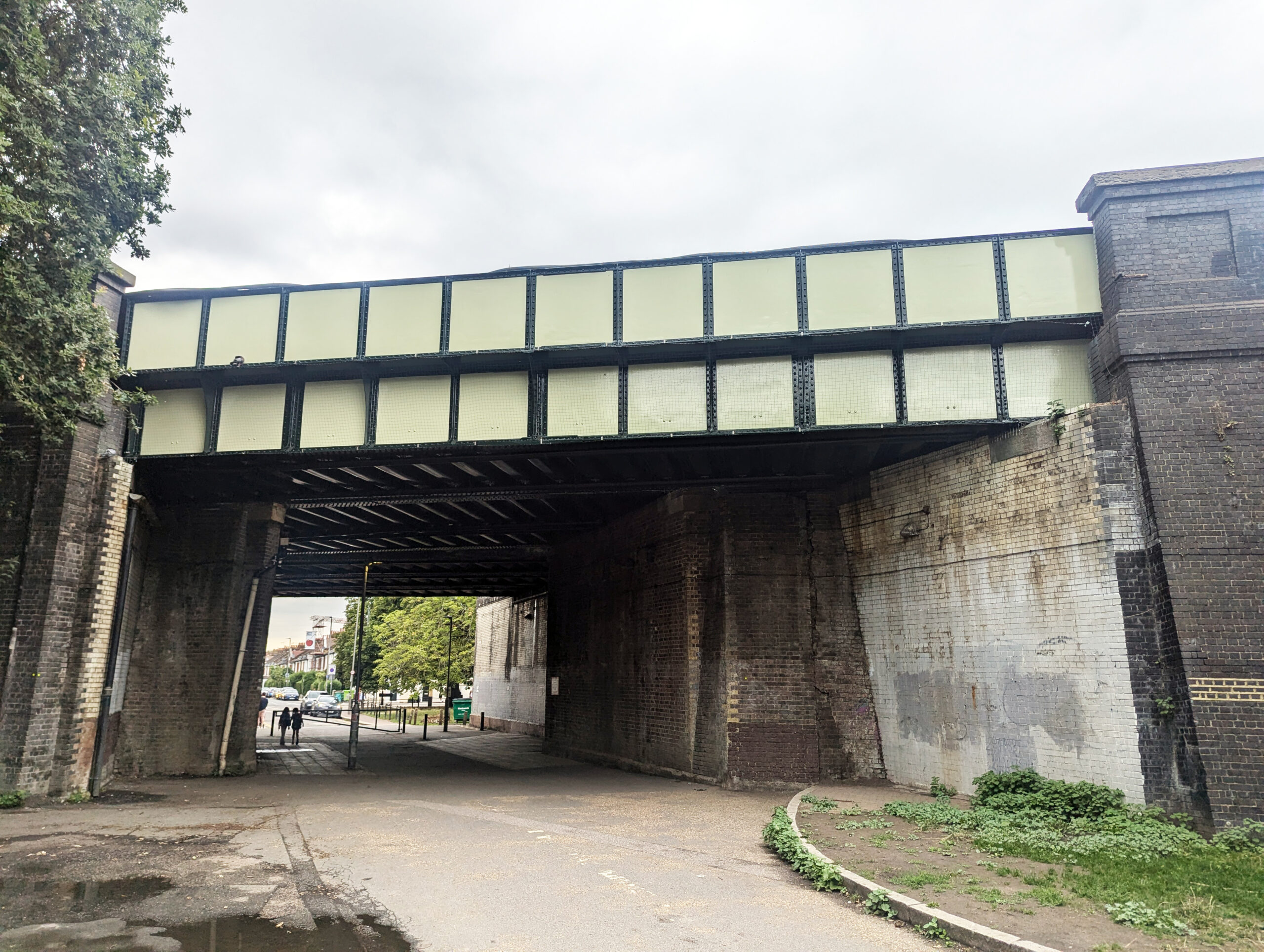
Robert West Consulting was engaged by Volker Fitzpatrick, acting as part of the Southern Renewals Enterprise (SRE), to provide comprehensive structural engineering services for the Cavendish Road Underbridge in Balham, South London. The aim: to assess, repair, and potentially strengthen the structure to meet RA10 rating and ensure serviceability for the next 30 years.
The Cavendish Road Underbridge is a single-span, metallic half-through structure, comprising five decks. It supports both the Up and Down lines of the Balham to Beckenham Junction (BBJ) railway over a key local route between Cavendish Road and Tooting Bec Common.
Robert West Consulting was responsible for conducting an Inspection for Assessment, followed by a detailed structural assessment. We identified and specified essential repairs, evaluated the need for strengthening, and delivered design solutions to extend the bridge’s service life. Our team also supported the construction phase, working closely with SRE to ensure safe, efficient implementation of the works.
VALUE-ADDED SOLUTION
For Cavendish Road Underbridge, Robert West Consulting delivered the full detailed design package for metallic repairs—and, if necessary, strengthening—on the two critical decks: Deck 4 (Up & Down main lines) and Deck 5 (siding). This involved a desktop study, specifying surveys to obtain necessary information to carry out the structural assessment of the bridge.
The initial brief called for new bearing stiffeners at the beam ends to add rigidity over the abutments. We proposed a sophisticated analysis approach: a non-linear finite-element analysis (NL FEA) using LUSAS, rather than a conventional linear elastic 1-D model. This methodology—presented to Network Rail via a Form AA—captures local yielding and subsequent stress redistribution across the bridge, providing a truer picture of the structure’s performance.
Network Rail endorsed the proposal, recognising that our NL FEA would either confirm or remove the need for stiffeners while keeping safety margins intact. Although NL FEA demands specialist expertise, it offered the clearest path to a cost-efficient, evidence-based design.
VALUE-ADDED OUTCOMES
The assessment produced measurable benefits:
- Higher capacity than required – Both operational decks achieved RA15 (versus the RA10 target).
- Elimination of bearing stiffeners – The analysis proved that added stiffeners were unnecessary.
- Lean repair strategy – By accurately modelling section losses and actual condition, we kept repairs to a minimum.
- Reduced on-site work – Fewer interventions meant lower cost, lower materials usage, and less disruption to rail and road users.
- Improved safety profile – Shorter possessions and fewer heavy lifts directly reduced construction-phase risk.
In short, our NL FEA approach delivered a safer and more economical solution—extending the bridge’s life while saving our client time, money, and carbon.